Case study · AI product · September 2026
Mirror Mirror
A beauty school that teaches on your own face.
Mirror Mirror turns a phone or laptop camera into a lit mirror and draws each makeup step onto the learner’s own face, live, while an AI teacher answers questions in a caption on the glass. I designed it on my own and built it with Claude Code on Base44 for the Build Your School sprint, and it took 1st place.
- What I owned
- All of it, on my own: the product idea, the flow map, the Figma design system and every screen. I directed the build with Claude Code, tested each round on my own face and shipped it.
- What changed because of me
- A phone or laptop camera became a lit mirror that draws each makeup step on the learner’s own face, live, with an AI teacher on the glass. It went from an idea to a live, free school in four days, and it won the sprint.
- By how much
- 1st place in the Base44 Build Your School sprint, announced by the organisers as the most votes a single build had pulled in a Base44 Discord sprint. 42 lessons in seven tracks plus six whole looks, with face tracking at 28 to 31 frames per second.
- Role
- Solo. Product, flows, design system and every screen. I directed the build, tested it and shipped it.
- When
- 4 to 7 September 2026, a four-day sprint.
- Tools
- Figma for design, then Claude Code on Base44, using live MediaPipe face tracking.
- Outcome
- 1st place in the Base44 Build Your School sprint.
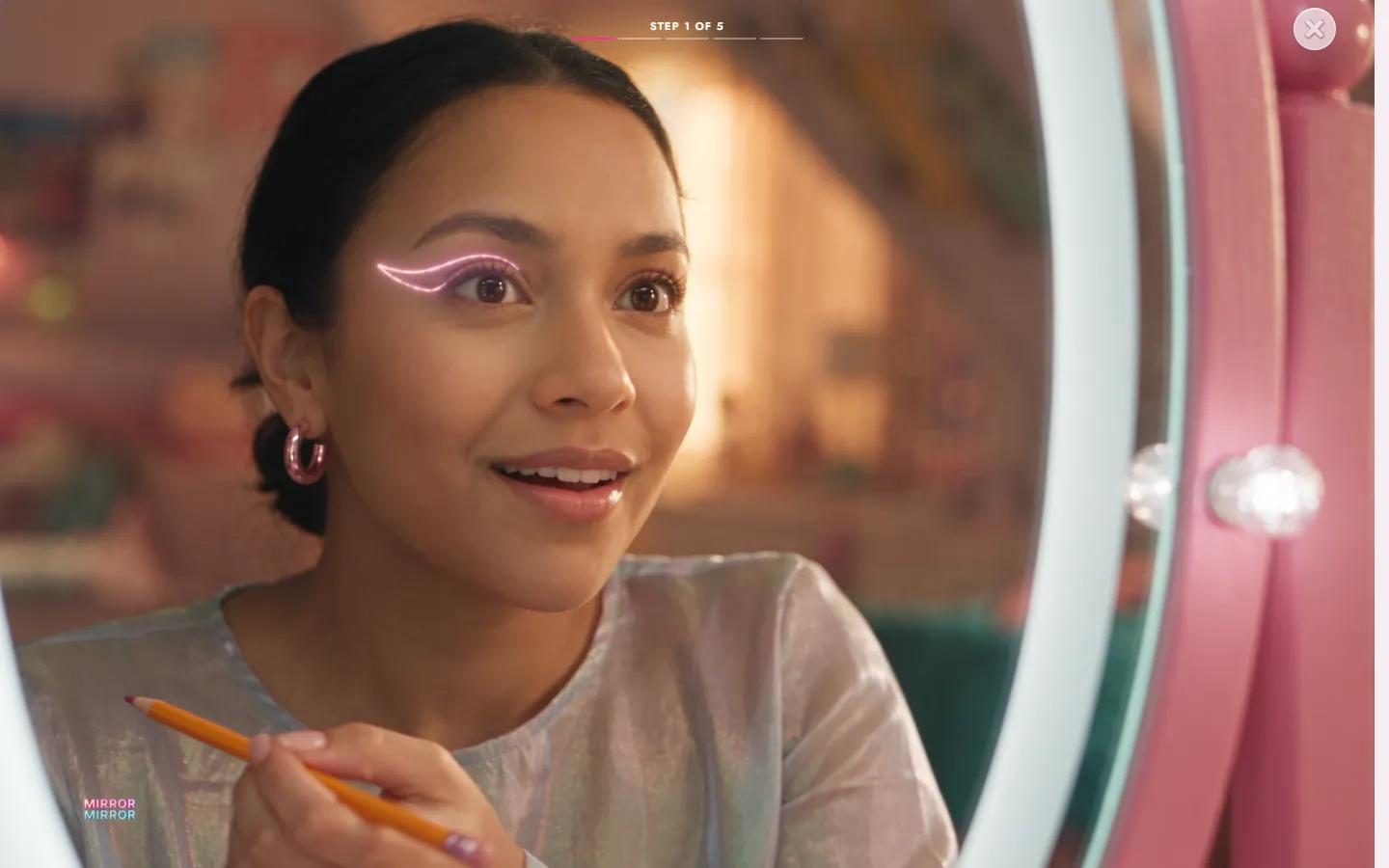
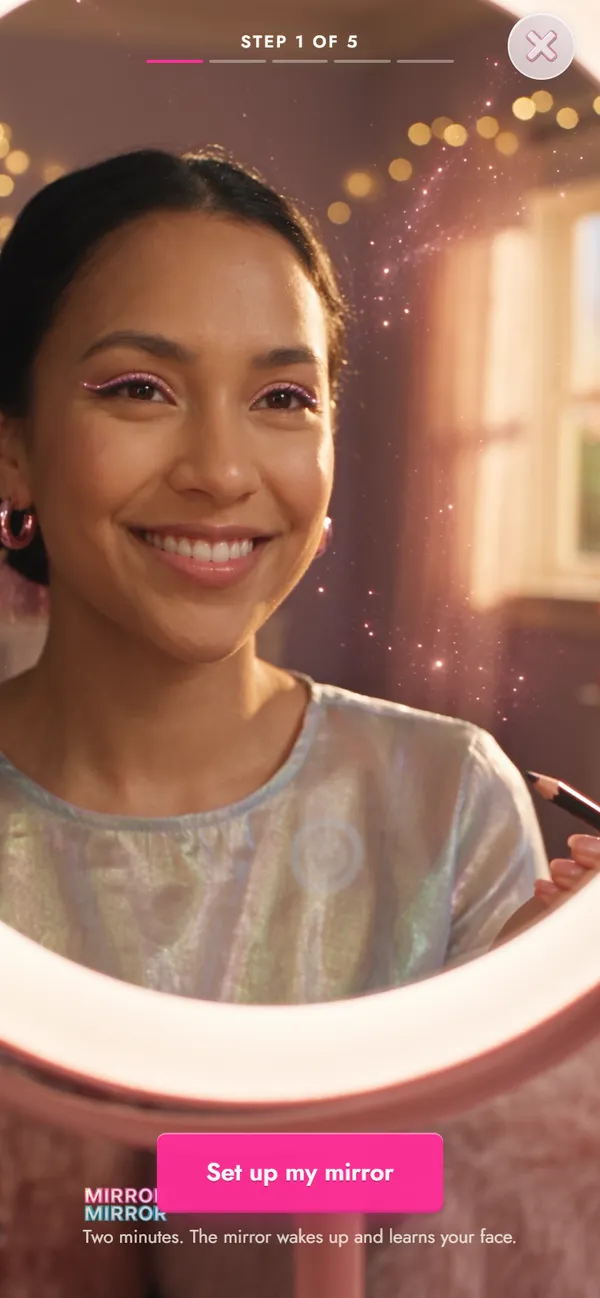
The first step of setup: what a guide looks like on a face.
The problem
Makeup videos teach on a face that is not yours.
The sprint brief was to build the school you wish you had had, for one named learner. Mine was me at fifteen, doing my first wing in the bathroom mirror with a YouTube tutorial paused on a laptop and no one to ask.
A video shows one face, at a speed you cannot follow, using products you do not own. You watch it, save it, and learn very little. Nobody learns to draw a line by watching it drawn on someone else’s eye.
So the school had to teach on the learner’s own face, with the products already in her bag, in an order that starts where she actually is.
Role and constraints
One person, four days, a camera that never uploads.
I did all of it on my own: the product definition, the page and flow map, the Figma design system and every screen. I built it with Claude Code on Base44, directing the face tracking, the guides and the AI teacher, testing each round on my own face, and shipping it.
- 01A sprint deadlineVoting closed at 8pm on 7 September. The school shipped before then, and the guides kept improving for two days after.
- 02No outside API keysThe teacher runs on the platform’s built-in language model, and face tracking runs in the browser with MediaPipe.
- 03Frames stay on the deviceThe camera is read frame by frame on the phone or laptop and never uploaded or kept. A picture leaves the device only when the learner takes one, and it goes to her own private album.
- 04Phone and desktopA phone propped on a sink and a laptop on a desk are both mirrors, so every screen exists at both sizes.
Process
The whole school on paper before the first screen.
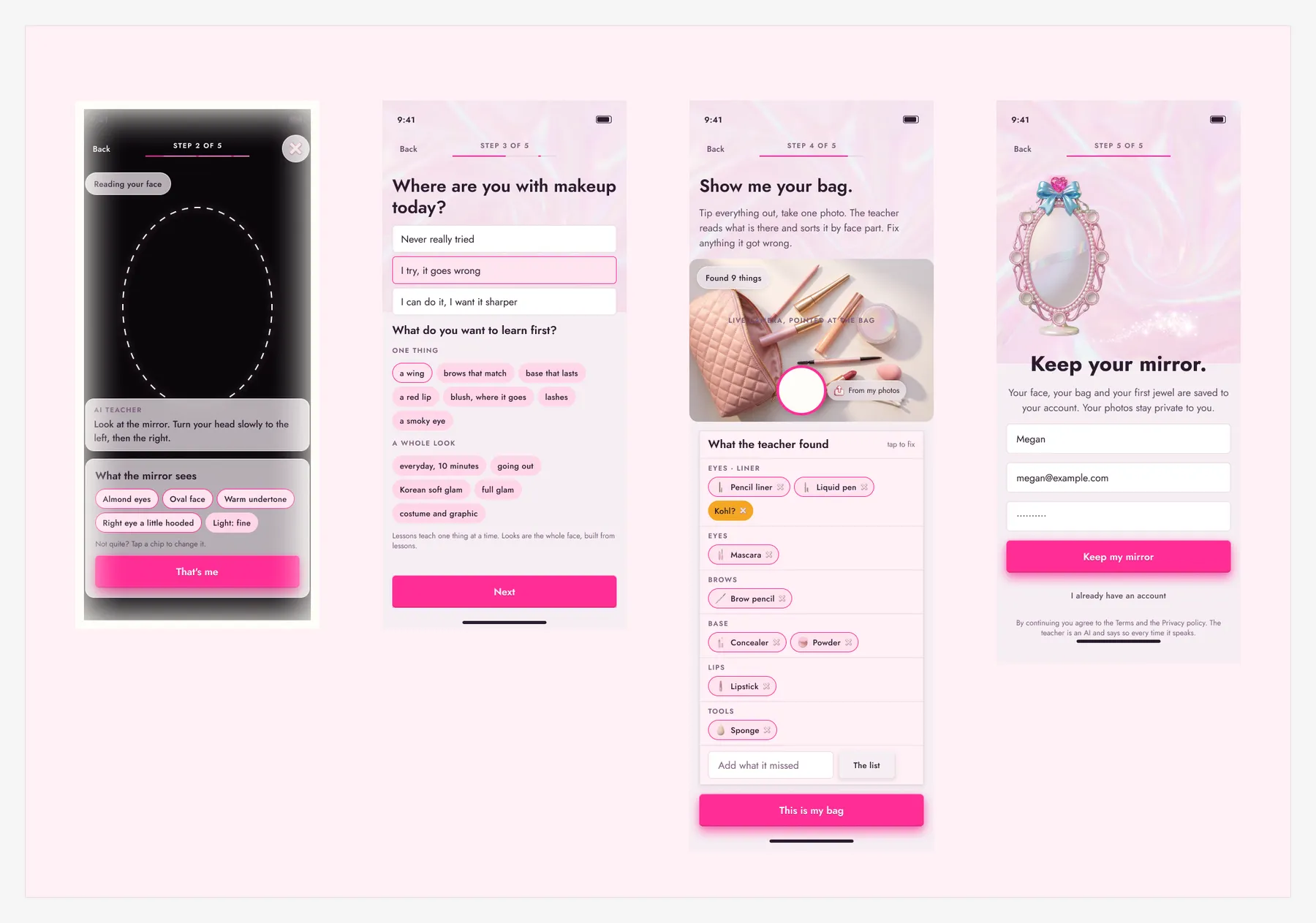
I started with a pages document that mapped 17 routes and 12 user flows, from setting up the mirror to finishing a whole look.
Then the design system in Figma: colour, spacing, radius and size variables, phone and desktop text styles, and a kit of core components (buttons, chips, inputs, toggles, the dock, lesson and look tiles). Every desktop and phone screen is built from it.
The first full pass in Figma rebuilt the written spec frame for frame, 41 frames of it. I rejected it. A redesign is supposed to improve the thing, not trace it, so the next version started from what a learner needs in front of a mirror and cut the rest.
Key decisions
What changed between the first build and the one that won.
Decision 01
Guides that look like makeup, not like an interface.
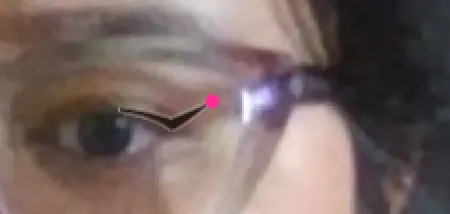
The first wing guide was a stroke with a dot at the end. On a real eye it read as a pointer, not as liner. A translucent brown version was too faint to follow, and the camera view was too small to see the detail.
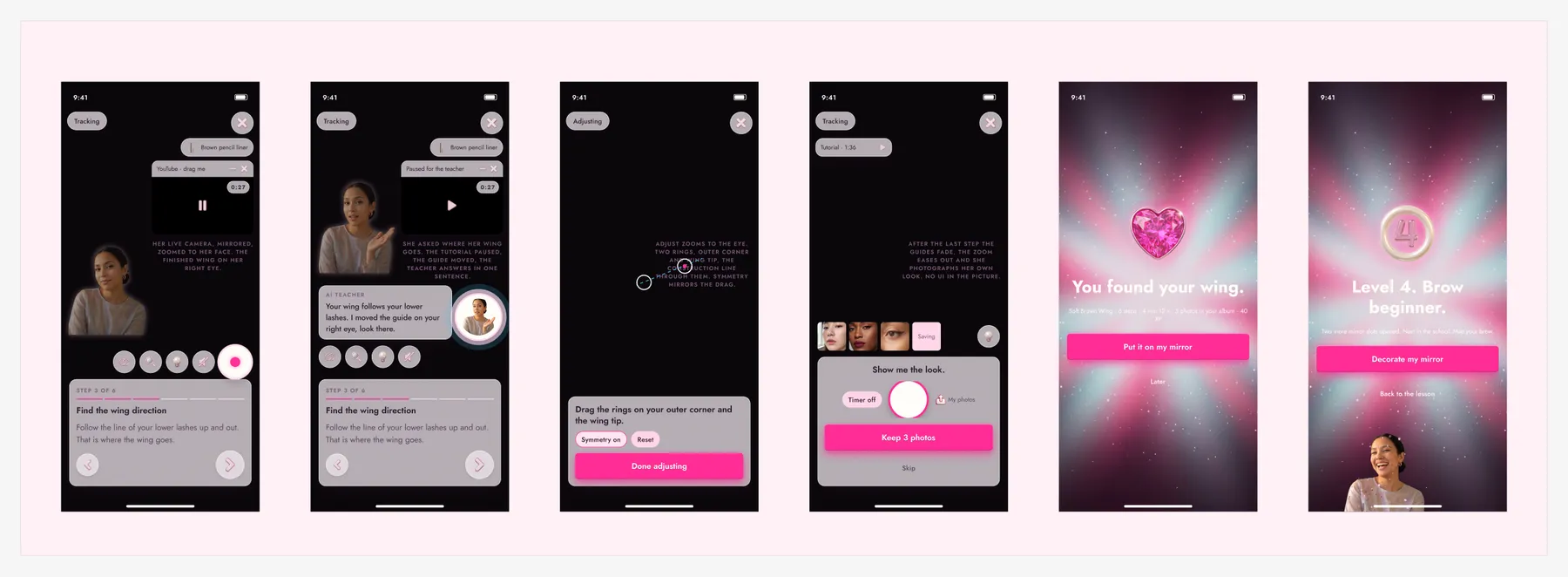
I redrew it over several rounds of testing on my own face. The mirror went full screen and zooms to the face, and the liner became an opaque espresso line that tapers into a real wing, with a trace mode. When the wing still looked dated, it got one straight top edge. Lips and brows moved to smooth curves with drag handles, so a learner can correct a guide that sits wrong, and the correction is remembered.
Then the rendering. Testing showed every guide being drawn on the eye, so I had each one moved to its own region of the face, with blend modes that let the skin show through the guide. The skin kept 88.6 percent of its texture variation, at 3.77 milliseconds a frame.
Before
Decision 02
Open on the mirror, not on a page about a mirror.
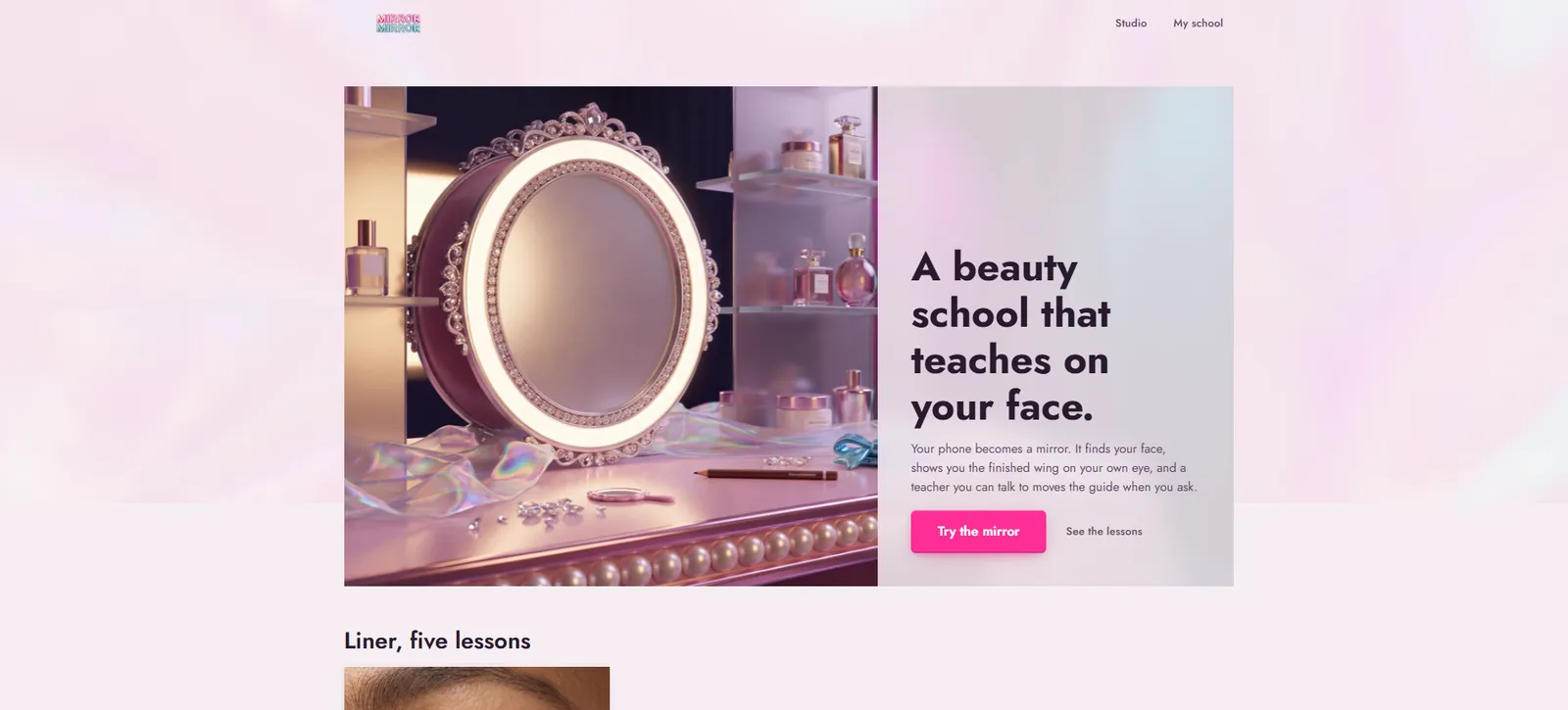
The first landing page put a rendered vanity on a pink gradient beside a headline. It explained the idea. It did not let anyone feel it.
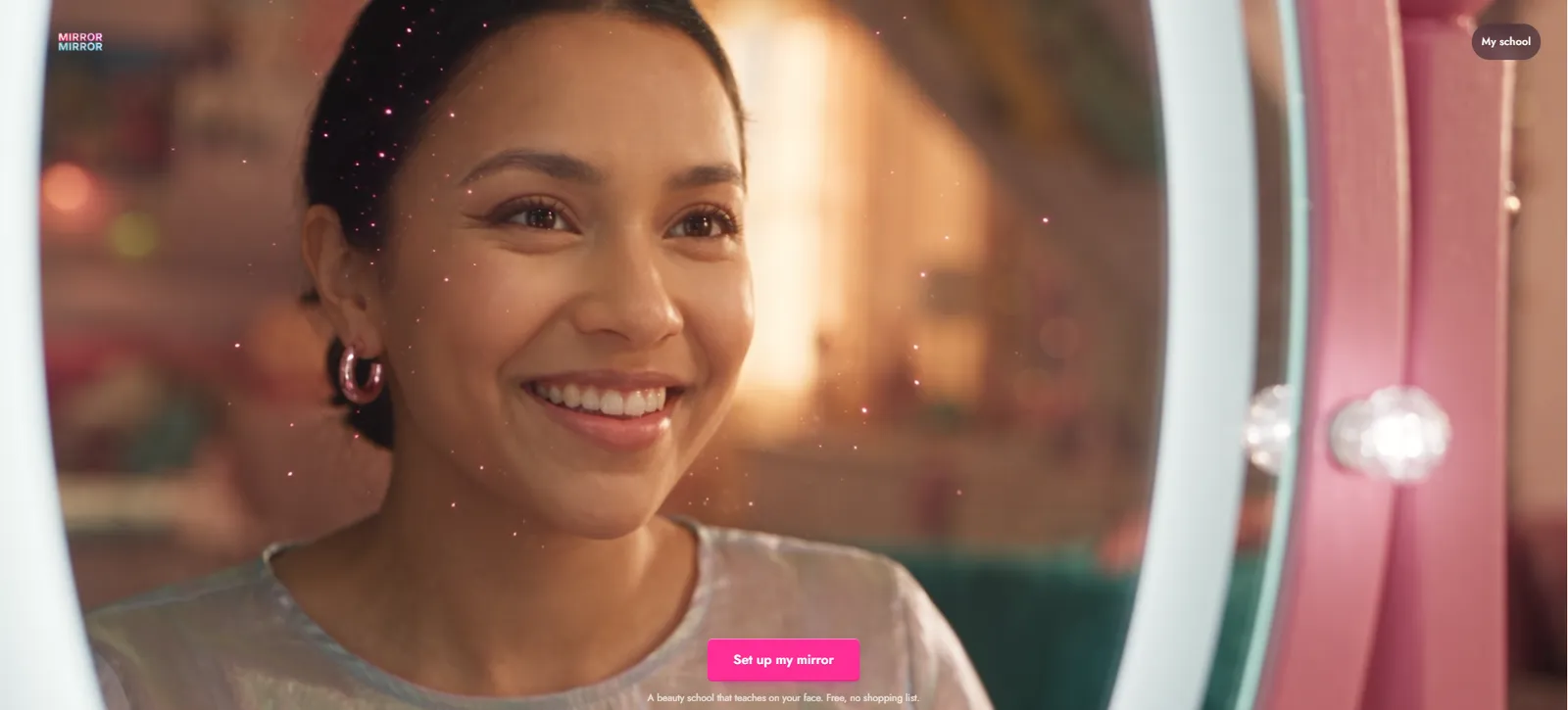
Two days later the landing page was the mirror itself: a full-bleed film of someone at a lit vanity, one button, and one line underneath. Gradients left the whole product at the same time.
Before · 5 Sep
After · 7 Sep
Decision 03
Privacy copy that is true, word for word.
A review of my launch copy found the privacy promise wrong in nine places. It said nothing ever left the device, but a photo uploads the moment the shutter is pressed.
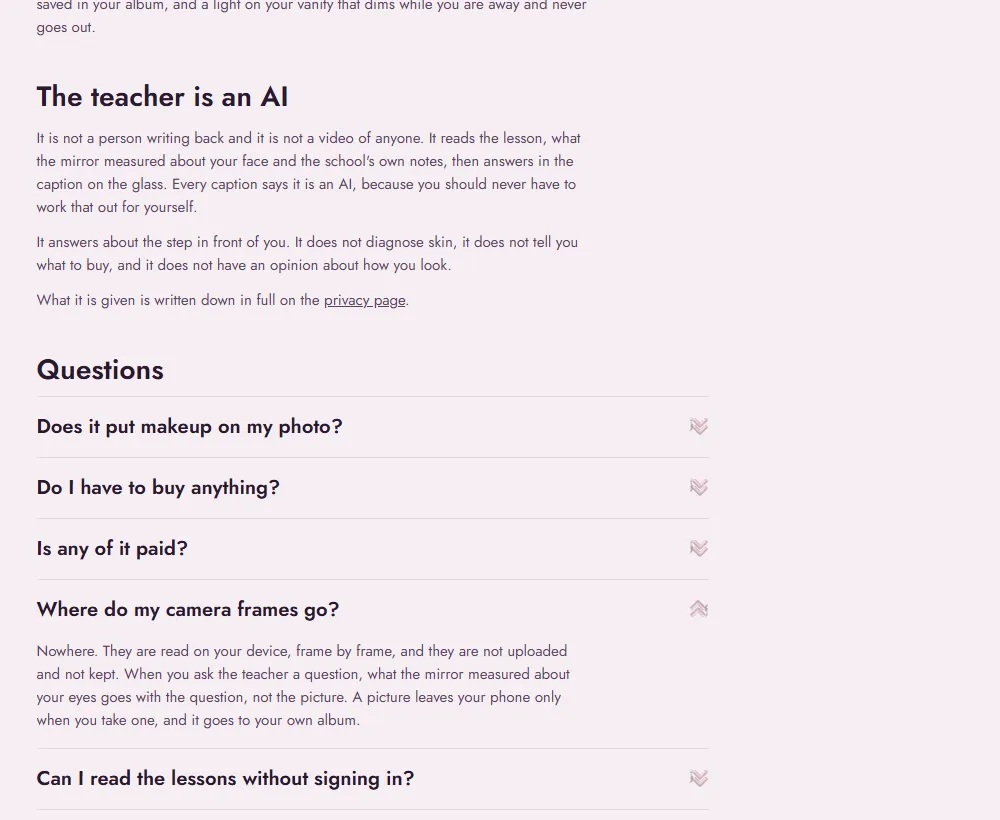
I rewrote every one of them to say exactly what happens. The video stays on the device. When the learner asks the teacher something, the measurements of her eyes go with the question, never the picture. A picture is uploaded only when she takes one, into her own album.
The teacher is an AI and every caption says so. It answers about the step in front of you. It does not diagnose skin, recommend products, or have an opinion about how anyone looks.
Decision 04
No shop, no feed, no paywall.
Most beauty content is selling something. I took the selling out. Every lesson is open to read without an account, nothing links to a shop, and anything a learner wants to buy goes on a 30-day wait list first, because most of the time she already owns something that does it.
Progress replaced the paywall. Seven levels each open something real (more slots on the mirror, adjust mode, the selfie timer), with a jewel for each liner lesson and a brooch for each finished track. The reason to come back is learning, not unlocking.
What shipped
A whole school, open to read.
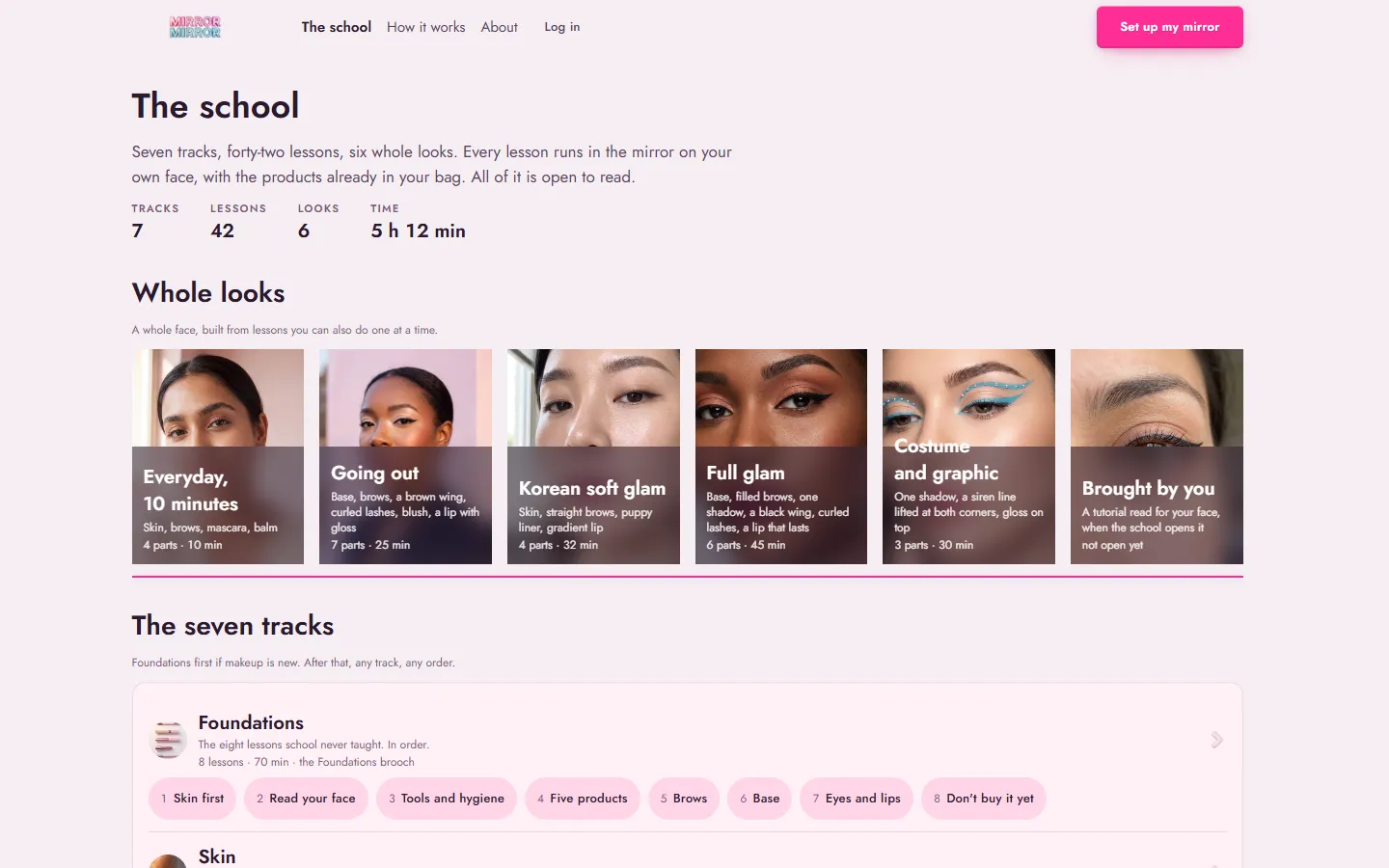
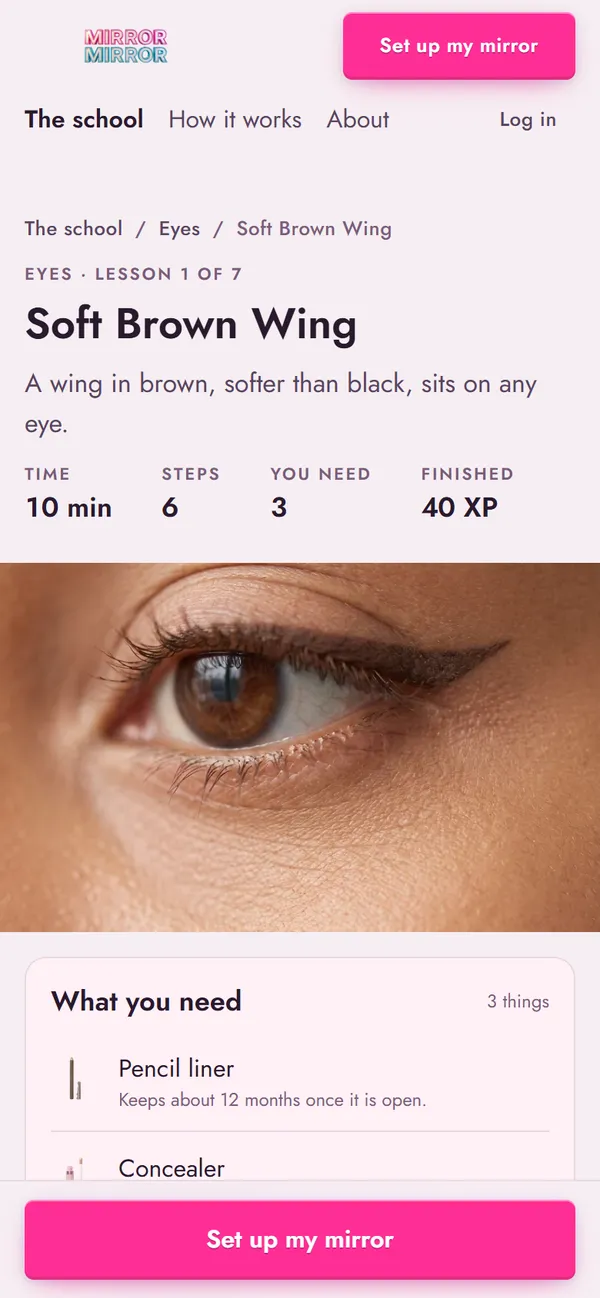
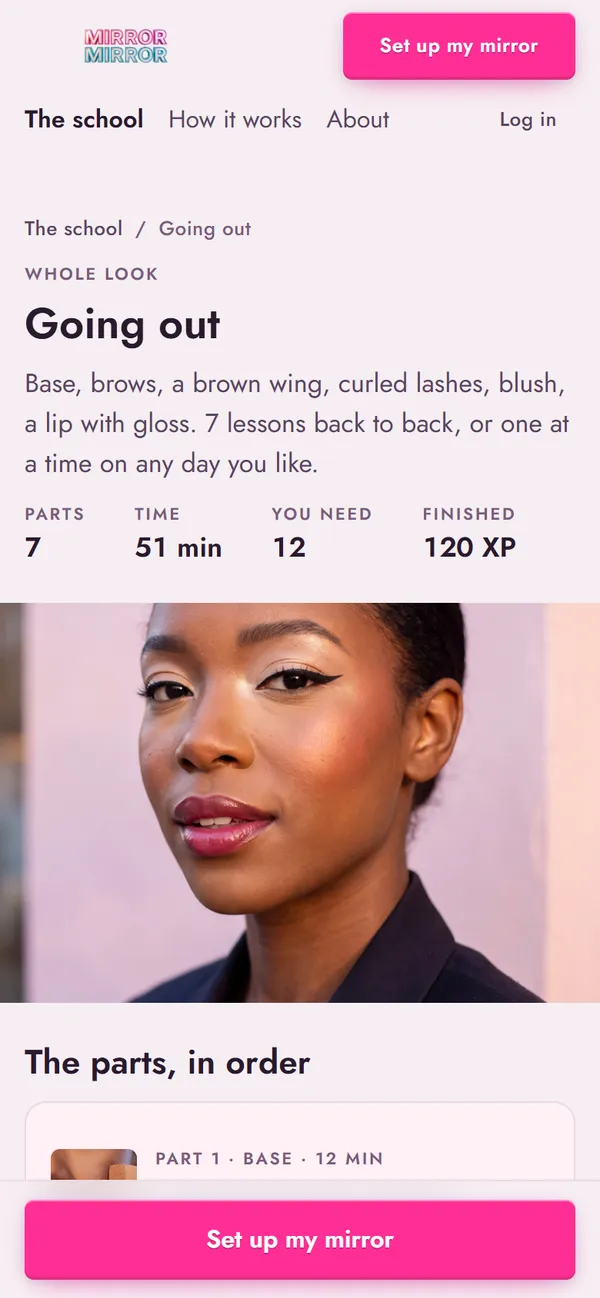
Seven tracks, 42 lessons and six whole looks, each one drawn on the learner’s own face. Around them: onboarding that reads face shape, eye shape, brows and lips and lets the learner correct what it found, a bag that reads products from one photo, an album, a vanity that keeps progress, gesture and voice controls, and an automatic screen light.
Results
1st place, and a record.
The organisers announced it as the most votes a single build had ever pulled in a Base44 Discord sprint. It is still live, and still free.
- Base44 Build Your School sprint, September 2026
- 1st
- Base44 Build Your School sprint, September 2026
- lessons in seven tracks, plus six whole looks, all free to read
- 42
- lessons in seven tracks, plus six whole looks, all free to read
- frames per second for face tracking in the first working build
- 28 to 31
- frames per second for face tracking in the first working build
What I would do next
- 01Measure tracking speed on Android phones, where it has not been tested yet.
- 02Ask for each product’s format in the bag (pencil, gel or liquid), so a lesson can change the technique to suit the tool.
- 03Delete the photos a learner discards, so nothing is stored that she chose not to keep.
- 04Give the teacher a voice, so a learner can keep her eyes on the mirror.